Parts of speech have specific tasks to perform when they are put together in a sentence
A noun (person, place, thing, or idea) functions as a sentence's subject when it is paired with a verb (action word) functioning as a sentence's predicate.
Every sentence has a subject and predicate. (Namely, a noun and a verb. BUT, because things start to get dicey the more elements you integrate into a sentence, we'll refer to the subject and predicate as exactly that and nothing else.)
Sometimes, the subject (noun) is directly paired with the predicate (verb).
Example:
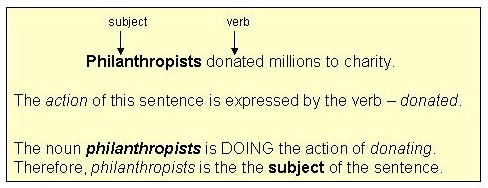
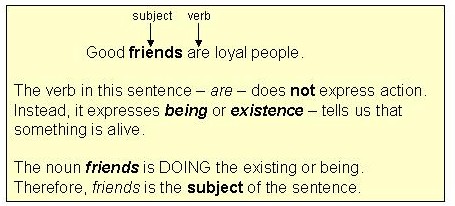
Sometimes a verb will express being or existence instead of action, necessarily. (Sometimes "being" is enough, isn't it?)("being" verbs are naturally a bit trickier to spot and rely on you putting on your "abstract reasoning hat.")
Example:
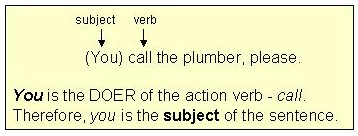
Sometimes we use sentences in which a subject is not actually stated at all, but is, nevertheless, understood in the meaning. (The answer, here, to the often-asked "hey Mr. Smith, why is something like 'go over there' a complete sentence despite having no clear discernable subject?")
Example:

A sentence like this gives an order or a request to someone.
Regardless of how a sentence is constructed (more on this later), every sentence must contain a subject and predicate -- implied or explicit. Without it, the sentence becomes a fragment.
[GO HOME]